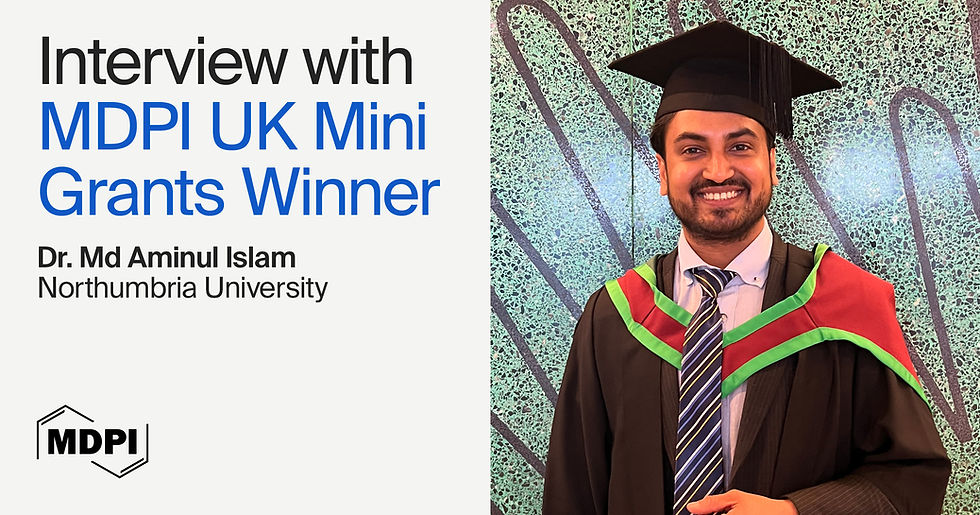
Interview with Dr. Wentao Zhang: Winner of MDPI UK Mini Grant Scheme: Fostering Science Communication Skills Amongst Early-Career Researchers

MDPI UK’s Mini Grants recognise and support the achievements of researchers within the scholarly community through the funding of non-research-based activities. We are pleased to announce one of the winners of the Mini Grants scheme, Dr. Wentao Zhang.
Dr. Wentao Zhang is a Research Assistant in the Power Electronics and Machines Centre at the University of Nottingham. His major research interests include the multi-physics design, analysis, and control of the electrical machine system.
Before joining the University of Nottingham, Dr. Zhang completed his PhD at Southeast University, Nanjing, China, which focused on the multi-physics analysis and design of hairpin winding permanent magnet traction machines for electric vehicles.
We spoke to Dr. Wentao Zhang about his current research interests and how he will be using the Mini Grant to foster science communication skills among early career researchers, helping them share their knowledge of electric mobility with wider communities.
Interview with Dr. Wentao Zhang— Making Engineering Research More Accessible Through Interactive Learning Experiences
Could you briefly introduce yourself and tell us about your current research interests?
I am a Research Assistant in the Power Electronics and Machines Centre at the University of Nottingham, which I joined in 2025 after completing my PhD at Southeast University in Nanjing, China.
My work is on electrical machines, the motors and generators inside electric vehicles, aircraft and renewable energy systems. Most of my time goes into building models that predict how a machine will behave before it is made and then checking those predictions against measurements.
My current interests are high-power-density machines with hairpin windings, multi-physics design methods, and physics-based, reliable digital twins. Alongside research, I am also interested in communicating research to the wider community, which is where the idea for this Mini Grant began.
What does receiving the MDPI UK Mini Grant mean to you, and what will you be using it for?
I was very pleased, partly because the grant supports work that sits outside the usual research outputs.
Early career researchers spend most of their time writing for specialists, and there are few chances to practise explaining our work to the people it is meant to serve. The grant will support “From Battery to Motion”, a small outreach project on electric mobility with two parts.
First, a group of PhD students and early career researchers will take part in practical training on explaining an engineering idea simply, starting from an everyday question and checking what the listener actually understood. The same group will then lead a free, hands-on public activity in which visitors can see for themselves how an electric drive turns energy into motion.
Most of the funding will go on reusable demonstration equipment and accessible materials, so the activity can be repeated well beyond this project.
What originally inspired you to pursue a career in research and academia?
I did not start with a fixed plan to become an academic. What drew me in was curiosity about why things work the way they do, and the satisfaction of a question that does not give way to the first answer.
During my PhD, I worked closely with an industrial partner on traction motors, and I saw how a careful piece of analysis could change a real design decision in a product that would be built in large numbers. That connection between understanding and use is what keeps me in research.
Academia adds something I value just as much, the chance to pass knowledge on.
What were some of the biggest challenges you faced in the early stages of your career as a researcher, and how did you overcome them?
The first was moving from being a PhD student, with a well-defined project and a supervisor close at hand, to being a researcher expected to choose my own questions.
Freedom is less comfortable than it sounds. I found it helpful to keep a short written list of open problems and to test each idea with colleagues before investing months in it.
None of these were solved quickly, but it became manageable once I stopped expecting to know everything at the start.
What advice would you give to those who are at the beginning of their academic careers?
Some practical habits have served me well.
First, keep careful records. A clear note of how a result was obtained saves days of work when a reviewer asks a question a year later, and it is the basis of research that other people can trust.
Second, explain your work to someone outside your field early and often. If you cannot describe your project to a friend in one sentence, it is usually a sign that the core idea is not yet clear in your own mind.
Third, look for mentors and, as soon as you can, become one. Helping a junior student through a problem often deepens your own understanding more than solving it alone.
Finally, be patient with yourself.
How can leading publishers build trust across the academic community, particularly with early career researchers?
Trust is earned through consistent practice rather than statements.
For early career researchers, the things that matter most are predictable and transparent processes: clear timelines, editorial decisions that come with reasons, and peer review that is rigorous whether the outcome is acceptance or rejection.
Publishers can also be open about costs, waivers and editorial policies, so that a researcher submitting a first paper knows exactly what to expect.
When early career researchers see a publisher acting in their interest over many years, trust follows.
What opportunities or challenges does the rising use of AI present for early career researchers?
The opportunities are real. AI tools can lower the barriers to writing code, searching the literature and polishing English, which is a genuine help for researchers like me who write in a second language.
In my own field, machine-learning models can speed up design studies that once needed thousands of slow simulations. The main challenge is that these tools can be confidently wrong, and an early career researcher may not yet have the experience to notice.
There is also a risk of skipping the slow work through which we learn the fundamentals, and that understanding is what lets us judge whether a result makes sense.
My own rule is simple: AI can help me draft and explore, but every number I report must trace back to a simulation, a calculation or a measurement I can check, and I am open about where AI tools were used. Used in this way, AI can make young researchers more productive without weakening the trust that research depends on.
Congratulations to Dr. Wentao Zhang for his time and effort, and we wish him success in his outreach project, and further research opportunities.
MDPI UK Mini Grants: Recognition and Support for Scholars
MDPI UK Mini Grants were launched to highlight and support the accomplishments of the UK scholarly community. Worth £500, they aim to fund non-research-based activities, such as outreach activities, soft-skills training courses and field trips.
Each grant is worth £500 and will be awarded to individuals or teams at UK universities or research institutions. These grants are intended to benefit PhD students, early career researchers, and the staff who support them.
For more information about MDPI UK Mini Grants and to apply, please visit the Mini Grants page.