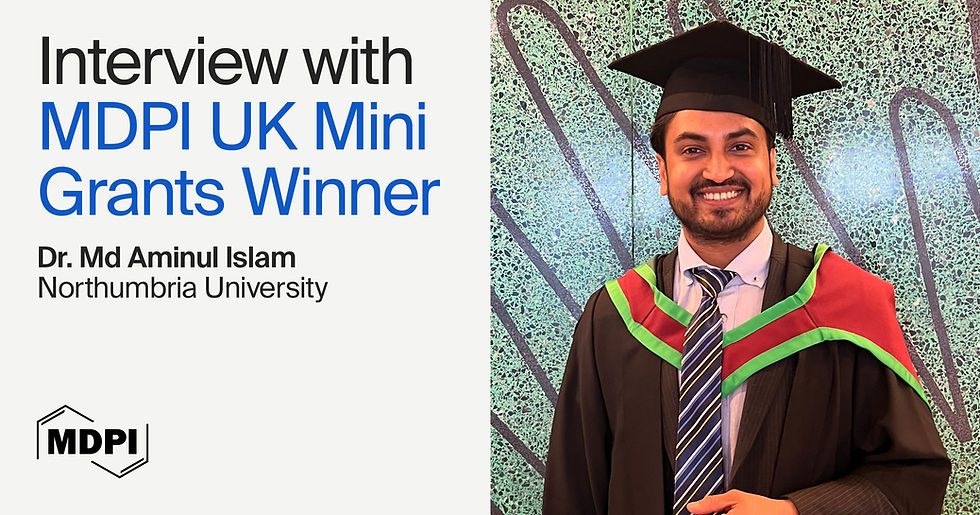
Interview with Dr. Mircea Zlotean: Winner of MDPI UK Mini Grants Scheme: Fostering understanding, transparency, and healthy research cultures within the community
Updated: Sep 3

The MDPI UK Mini Grants initiative actively recognises and supports the achievements of researchers, helping to strengthen and sustain the research culture within UK universities and research institutions. We are pleased to announce one of the winners of the Mini Grants initiative, Dr. Mircea Zloteanu.
Dr. Mircea Zloteanu currently works as a Lecturer in Psychology and Criminology (Education), at the Institute of Psychiatry, Psychology & Neuroscience at King's College London.
Dr. Zloteanu’s research focuses on emotions, decision-making, user behaviour in the Sharing Economy, and deception detection. His recent research interests have been on meta-research and meta-psychology, with a focus on methods, statistics, and open science.
Dr. Zloteanu is a Chartered Psychologist with the British Psychological Society and a Fellow of the Higher Education Academy. He is also the UK Reproducibility Network Local Co-Lead, and member of the ReproducibiliTea network.
We spoke to Dr. Zloteanu about his current research interests, and what inspired him to pursue a career within his chosen field, as well as how he will be using the Mini Grant to further support his goals, such as creating a healthier research culture within his academic network.
Interview with Dr. Mircea Zlotean—Encouraging networking and exchange within the research community
Could you briefly introduce yourself and tell us about your current research interests?
I am a Lecturer in Psychology and Criminology at King’s College London. My research spans deception and credibility assessment, emotion perception, decision-making, and investigative interviewing. I also have a strong interest in research methodology, particularly statistical inference, reproducibility, transparent reporting, and improving how researchers draw conclusions from data.
What does receiving the MDPI UK Mini Grant mean to you, and what will you be using it for?
The grant provides an opportunity to organise a workshop on statistical inference and research uncertainty. The event will address common interpretive pitfalls, responsible communication of non-significant and unexpected findings, and ways of extracting more useful knowledge from existing research. Its broader aim is to promote statistical understanding, transparency, openness, and a healthier research culture.
What originally inspired you to pursue a career in research and academia?
I have always enjoyed learning, questioning ideas, and developing my understanding of complex topics. Academia appealed to me because intellectual curiosity and continued learning are central to the work.
I also greatly enjoy teaching. Sharing knowledge, encouraging critical thinking, and helping prepare the next generation of researchers are among the most rewarding aspects of my role.
What have been some of the biggest challenges you have faced as an early-career researcher, and how did you overcome them?
One challenge has been developing an independent academic voice and becoming comfortable discussing or challenging ideas presented by established researchers. That can initially feel daunting.
Over time, I came to recognise that constructive disagreement is an essential part of science. Researchers at every career stage should be able to contribute, provided their arguments are informed, respectful, and open to scrutiny.
What role do you think Open Access journals play in advancing research and fostering scientific exchange within the community?
Open access is an important part of making scientific knowledge more widely available. As someone involved with the UK Reproducibility Network (UKRN) and other open research initiatives, I try to consider how my work can be accessed, evaluated, and reused by others.
Researchers should not be prevented from reading relevant work simply because they or their institutions cannot afford subscription access. Open access is therefore valuable, although it must be accompanied by appropriate standards of quality, transparency, and research integrity.
What advice would you give to those who are at the beginning of their academic careers?
Invest time in understanding methodology and research design. These subjects may not appear as exciting as conducting a study or obtaining a novel result, but they pay substantial dividends.
Understanding what a design can investigate, what an analysis estimates, and which conclusions the evidence can support will make you a more careful, credible, and ultimately more productive researcher.
Congratulations to Dr. Mircea Zloteanu for his time and effort, and we wish him success in his workshop, and further research opportunities.
About MDPI UK Mini Grants
MDPI UK Mini Grants were launched to recognise and support the accomplishments of the UK scholarly community. They aim to fund non-research-based activities, such as outreach activities, soft-skills training courses and field trips.
Each grant is worth £500 and will be awarded to individuals or teams at UK universities or research institutions. These grants are intended to benefit PhD students, Early Career Researchers, and the staff who support them.
For more information about MDPI UK Mini Grants and to apply, please visit the Mini Grants page.