
Interview with Dr. Md Aminul Islam: Winner of MDPI UK Mini Grant Scheme: Reimagining Higher Education to Create a Better and More Equitable Future
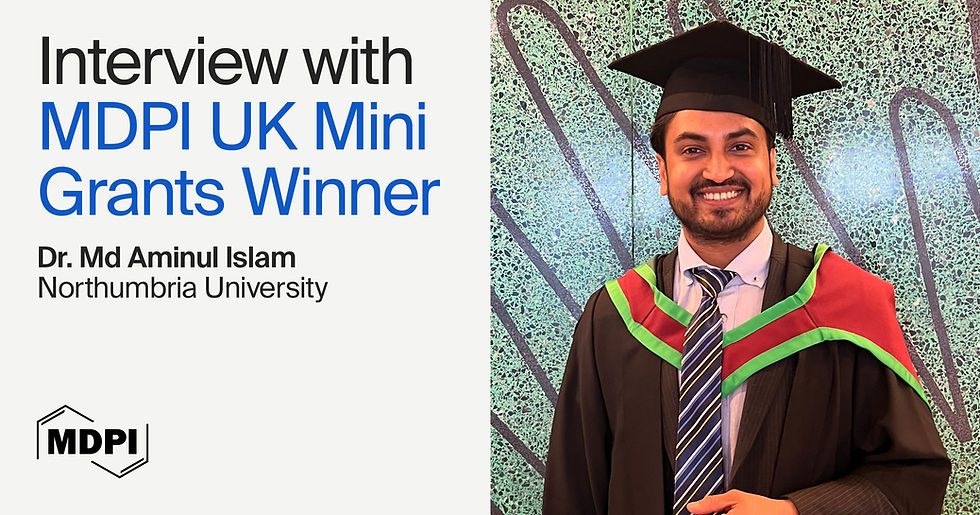
The MDPI UK Mini Grants scheme was designed to highlight and support the achievements of researchers, helping to strengthen the research culture within UK universities and research institutions. We are pleased to announce one of the winners of the Mini Grants scheme, Dr. Md Aminul Islam.
Dr. Md Aminul Islam is a Research Lead in Computing and Cisco academy instructor, at Regent College London, as well as a dissertation supervisor at Northumbria University London. His work explores applied artificial intelligence, cloud security, and DevOps, with a particular focus on TLA.
Dr. Islam is dedicated to fostering a research-orientated environment within his workplace, with a focus on intellectual engagement and research activity, that benefits students and staff through specialised workshops and academic events.
With more than two dozen peer-reviewed publications and nine patents and designs from the UK, Canada and India, Dr. Islam’s expertise in computer science and his commitment to evidence-based research, helps to guide his work as a teacher.
We spoke to Dr. Md Aminul Islam about his current research interests and what inspired him to pursue a career within research and academia, as well as how he will be using the Mini Grant to further support his goals, such as creating a lasting cross-institutional network of early career researchers.
Interview with to Dr. Md Aminul Islam—Forming a Cross-Institutional Network, Committed to a Sustainable Higher Education
Could you briefly introduce yourself and tell us about your current research interests?
I am a Research Lead in Computing, at Regent College London (affiliated by the University of Greater Manchester), and Dissertation supervisor at Northumbria University London. My research sits at the intersection of applied artificial intelligence, cloud security, DevOps, with a particular focus on TLA. I also hold fellowships from the Higher Education Academy and the Royal Society of Arts and have published peer-reviewed work with IEEE and Springer, alongside five registered patents in AI-powered systems.
What does receiving the MDPI UK Mini Grant mean to you, and what will you be using it for?
Receiving this grant is genuinely meaningful not just as recognition, but as a catalyst. I will be using the funding to organise a London Researcher Network Day, bringing together approximately 20 doctoral researchers from universities across Greater London whose work focuses on AI, teaching, learning, assessment, and cloud security.
The day will combine a morning idea-sharing forum on sustainable higher education with an afternoon group visit, connecting academic discourse with the policy environment in which higher education operates. Beyond the event itself, what excites me most is what it initiates: a lasting cross-institutional network of early career researchers committed to reimagining higher education for a better and more equitable future. The MDPI UK Mini Grant makes that possible.
What originally inspired you to pursue a career in research and academia?
My inspiration came early and from close to home. I come from a family with a deep tradition in education; teaching runs across generations and I began teaching myself in my mid-teens. That early experience of watching knowledge transform people instilled in me a conviction that education is not simply a profession but a form of public service.
As I progressed through my own studies in computer science and AI, I became increasingly fascinated by the questions that did not yet have answers, the gaps where rigorous inquiry could make a real difference. Research felt like the natural home for that curiosity.
Academia gave me the space to pursue it with integrity, in community with others who share the same commitment.
What have been some of the biggest challenges you have faced as an early-career researcher, and how did you overcome them?
The most persistent challenge has been navigating the structural barriers that early-career researchers face, namely, limited institutional support, competitive funding landscapes, and the difficulty of building visibility in a crowded academic environment, particularly as a researcher from a minority background working across multiple institutions simultaneously.
I overcame these challenges by being deliberate about community. I sought out mentors, built peer networks across institutional boundaries, engaged with professional bodies including IEEE, IET, and BCS, and pursued opportunities fellowships, grants, editorial roles that expanded both my skills and my connections.
I also learned to treat rejection not as a verdict but as redirection. Every unsuccessful application taught me something that improved the next one.
What role do you think Open Access journals play in advancing research and fostering scientific exchange within the community?
Open Access is one of the most democratising forces in contemporary scholarship. Research funded by public institutions and public money should not be locked behind paywalls that exclude the very communities it is designed to serve.
Open Access journals like those published by MDPI ensure that a doctoral student in Dhaka, a teacher in rural Kenya, or a policymaker in East London can access the same knowledge as a researcher at a well-resourced university. This is not a peripheral concern; it is foundational to the integrity and social value of the entire research enterprise.
I am a strong advocate for open science principles, and I believe that the wider adoption of Open Access publishing will accelerate innovation, reduce duplication, and genuinely democratise knowledge.
What advice would you give to those who are at the beginning of their academic careers?
Three things above all. First, build community before you need it, the relationships you invest in early will sustain you through the inevitable difficult periods of academic life.
Second, do not wait until you feel ready, submit the paper, apply for the grant, pitch the idea. Confidence in academia is built through action, not preparation.
Third, stay connected to your purpose. The procedural demands of academic life are metrics, publications, grant applications, etc.; these can gradually obscure the reason you started. Revisit that reason regularly. The most enduring academic careers are built not on performance but on genuine curiosity and a sincere desire to contribute something of value to the world what we call ‘Impact’.
Congratulations to Dr. Md Aminul Islam for his time and effort, and we wish him success in his networking event, and further research opportunities.
MDPI UK Mini Grants: Supporting Scholarly Achievements
MDPI UK Mini Grants were launched to recognise and support the accomplishments of the UK scholarly community. They aim to fund non-research-based activities, such as outreach activities, soft-skills training courses and field trips.
Each grant is worth £500 and will be awarded to individuals or teams at UK universities or research institutions. These grants are intended to benefit PhD students, Early Career Researchers, and the staff who support them.
For more information about MDPI UK Mini Grants and to apply, please visit the Mini Grants page.


